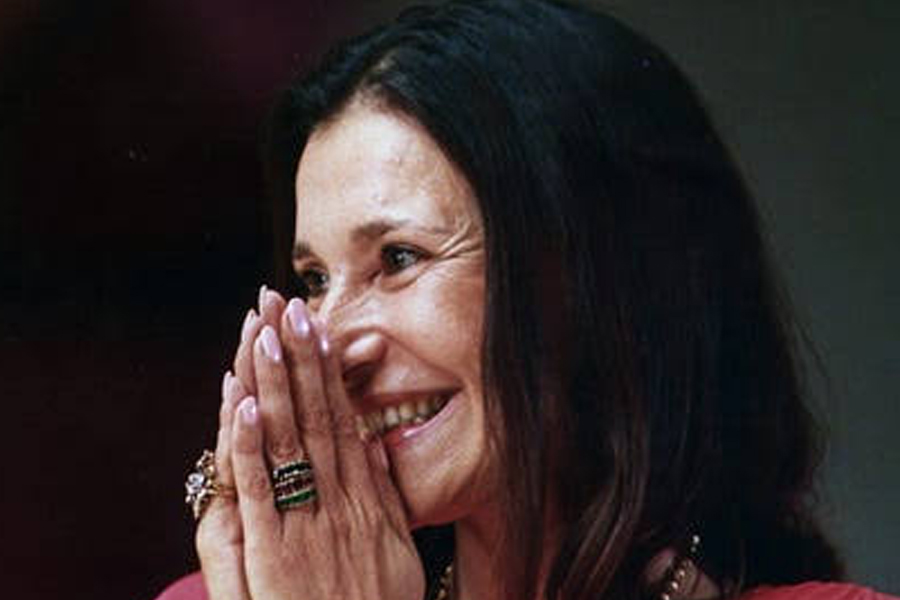
Who Was Francoise Ruddy
Francoise Ruddy, born Francoise Wizenberg on April 4, 1937, in Paris, France, lived a life that crossed some of the most unexpected worlds of the twentieth century. She was a Holocaust survivor, a Hollywood insider, the former wife of celebrated film producer Albert S. Ruddy, and eventually a devoted follower and personal secretary of the Indian spiritual teacher Bhagwan Shree Rajneesh, widely known as Osho.
Her story moved from wartime Europe to affluent American society, from the film industry to a controversial spiritual commune in Oregon. Each chapter brought a different identity, yet the experiences of her childhood appeared to remain an important part of the person she became.
Known within the Rajneesh movement as Ma Prem Hasya, she developed a reputation for warmth, organizational ability, generosity, and an unconventional approach to life. Her relationships with wealthy businessmen, Hollywood personalities, spiritual seekers, and members of her family connected her to several influential circles.
Francoise died on August 19, 2014, at the age of 77. Although she was never as publicly famous as her second husband, her life offers a remarkable glimpse into the intersection of personal reinvention, family history, cinema, and spirituality.
Early Life and Survival During the Holocaust
Francoise was born to Polish Jewish parents, Icek Wizenberg, also identified as Izak or Yitzhak, and Maria Wilczuk. Her early childhood unfolded during a period when Jewish families across Europe faced increasing persecution under Nazi rule.
Her father died in a Nazi concentration camp during World War II. The loss left her mother with the responsibility of protecting her young daughter in circumstances where a child’s identity could become a matter of life and death.
To save Francoise, Maria arranged for her to live with a Christian family under a false identity. The child was instructed to conceal her Jewish background. Some accounts describe her wartime experiences as including time in a Polish convent, where she adopted the appearance and habits of a Catholic child.
The arrangement offered protection, but it also created a complicated emotional situation. Francoise was separated from her mother and taught to deny an essential part of her identity. When they reunited after the war, reportedly when Francoise was around eight years old, they had to rebuild their relationship after years of fear and separation.
I find this part of her story particularly revealing because survival was not simply a matter of escaping physical danger. It also meant recovering a sense of belonging after childhood had been shaped by secrecy.
Her mother, Maria, remained a central figure in her life. The determination that had helped Maria protect her daughter during the Holocaust continued to influence the family’s decisions in the years that followed.
Growing Up in Israel and Moving to North America
After the war, Francoise and her mother moved to Israel. She spent part of her youth in the country, including time connected with kibbutz life, which emphasized communal living, shared responsibilities, and collective ideals.
Israel offered a new beginning, but it also presented challenges. Francoise was approaching the age when military service would become a significant part of life for young Israelis.
One family anecdote recounts that Maria became alarmed after seeing the results of her daughter’s firing-range practice. The story describes Maria’s fear that, after saving Francoise from the Nazis, she might lose her daughter to another conflict. Whether repeated in precisely those words or not, the anecdote captures the intensity of a mother determined to protect her child.
The family subsequently moved to Canada and later to the United States, including New York. These moves broadened Francoise’s horizons and brought her into contact with the opportunities and social expectations of North American life.
Her early experiences had exposed her to displacement, cultural adaptation, and the need to begin again. Those themes would recur throughout her adulthood, although her later transformations would be driven by personal choice rather than wartime necessity.
Her First Marriage to Guilford Glazer
In 1956, at just 19 years old, Francoise married Guilford Glazer, a wealthy Jewish real estate developer from Knoxville, Tennessee. Glazer, born in 1921, was approximately 16 years older than her.
The marriage introduced Francoise to a world of considerable financial privilege. Glazer eventually became known for his real estate investments, including his association with the development of the Del Amo Fashion Center in California. He also became a prominent philanthropist, particularly in connection with Jewish causes and support for Israel.
Their life together reportedly included a large home, domestic staff, elaborate entertaining, and access to affluent social circles. Francoise later described a household where material comforts were abundant. Accounts of her recollections refer to a 35-room house and expensive floral arrangements for parties.
Yet wealth did not necessarily bring fulfillment.
Francoise reportedly explained that her decision to marry Glazer was not primarily motivated by money or romantic love. Instead, she felt safe with him, a powerful consideration for someone whose childhood had been marked by persecution and separation.
Over time, however, the life of a wealthy wife and mother became restrictive. She reportedly grew dissatisfied with the predictable routines of high society and the role of a conventional suburban mother.
The marriage ended in divorce around 1964 or 1965. Francoise received a substantial settlement, although the exact amount has not been reliably established in public accounts.
Glazer later married Diane Pregerson Glazer and continued building his business and philanthropic legacy.
Her Children Emerson Glazer and Erika J Glazer
Francoise and Guilford Glazer had two children, Emerson Glazer and Erika J. Glazer. Their family history connects Francoise’s personal journey with a broader legacy of business success, philanthropy, and civic involvement.
Emerson Glazer
Emerson Glazer, born around 1957, is Francoise’s son from her first marriage. He has been associated with real estate, reflecting a professional field closely connected to his father’s business interests.
Compared with his sister, Emerson has maintained a relatively low public profile. Detailed information about his personal life, relationships, and professional activities is limited, and it is important not to mistake that limited public record for an absence of achievement.
His place in the family is significant because he represents a branch of the Glazer legacy that has attracted less media attention than his sister’s philanthropic work.
Erika J Glazer
Born in 1959, Erika J. Glazer was a notable Los Angeles philanthropist. She has funded medical research, Jewish institutions, cultural organizations, and charities.
Women’s heart health is her focus. Her philanthropy has funded Cedars-Sinai endowed jobs and research on women’s cardiovascular disease.
She has also contributed greatly to Jewish community life. In honor of her assistance, the Wilshire Boulevard Temple facility in Koreatown became the Erika J. Glazer Family facility.
Her charity goes beyond medicine and religion. She supports Hammer Museum projects that make art more accessible. Other philanthropic endeavors include supporting Israel and wounded Israeli troops.
Erika owned Golden State Warriors interests between 2014 and 2015.
Her public identity differs from her mother’s spirituality. While Francoise spent much of her later life supporting the Rajneesh movement, Erika focused on institutional and community philanthropy.
At Erika’s home in August 2014, Francoise died. Her daughter was with her during this final chapter, adding a personal touch to a life remembered by public individuals and dramatic historical locations.
Her Second Marriage to Albert S Ruddy
Following her divorce from Glazer, Francoise entered a different social world through her relationship with Albert S. Ruddy.
Born in Montreal in 1930, Ruddy became one of Hollywood’s best-known producers. His career included two Academy Awards for Best Picture, one for The Godfather and another for Million Dollar Baby. He was also associated with the creation of the television comedy Hogan’s Heroes.
Francoise and Albert married around 1967. Their relationship brought her closer to the film industry, where creative ambition, business negotiations, and unpredictable production schedules contrasted with the routines of her earlier life.
She was associated with Alfran Productions, a company name combining elements of Albert and Francoise. The company was connected with films including The Godfather, Little Fauss and Big Halsy, and Making It.
Francoise and the Making of The Godfather
Released in 1972, The Godfather became one of the defining films in American cinema. Its success transformed Ruddy’s professional reputation and secured its place in film history.
Francoise was connected to the production through her marriage and her association with Alfran Productions. Some accounts also credit her with offering support and ideas during Ruddy’s demanding work on the film.
However, her precise creative contributions are not as well documented as Ruddy’s role as producer. It is more accurate to describe her as part of the personal and professional environment surrounding his career than to assign her specific production achievements without clear evidence.
She also moved among Hollywood personalities and reportedly developed friendships with actors and filmmakers, including Marlon Brando and Robert Redford.
Her experiences during this period were not limited to being a producer’s wife. Contemporary accounts describe her interest in independent film projects, including a proposed adaptation of Anais Nin’s novel Seduction of the Minotaur. The project did not reach completion.
Francoise and Albert eventually divorced during the 1970s. Ruddy later married Wanda McDaniel, with whom he had two children, Alexandra and John.
Ruddy died in May 2024, renewing public interest in his earlier marriage to Francoise and her subsequent transformation into a leading figure within the Rajneesh movement.
Her Journey Into Spirituality and the Rajneesh Movement
By the late 1970s, Francoise had begun searching for something beyond the material success she had experienced in her earlier marriages.
Her encounter with the teachings of Bhagwan Shree Rajneesh, later known as Osho, marked one of the most consequential changes in her life. After meeting people associated with the movement in Hollywood, she traveled to the spiritual community in Pune, India.
In 1977, she took sannyas, a commitment to the movement’s spiritual path, and adopted the name Ma Prem Hasya. The name Hasya is associated with laughter, while the full name conveyed an identity connected to love and spiritual practice.
She described the change as an awakening from boredom and superficiality. In accounts attributed to her, she explained that her earlier life had been exciting and fast-paced but had not brought a satisfying understanding of herself.
The movement offered an alternative framework. Rather than defining herself through marriage, wealth, or social standing, she could pursue meditation, self-examination, and a different form of community.
Her decision was not merely symbolic. Francoise brought considerable organizational experience and personal resources to the movement. She became a supporter of Osho’s activities and was associated with efforts to secure the Oregon ranch that eventually became Rajneeshpuram.
The transition was striking. A woman who had once entertained guests in wealthy American homes now helped support a large spiritual community in the American Northwest.
Her Role at Rajneeshpuram in Oregon
Rajneeshpuram was established during the early 1980s on the Big Muddy Ranch in Oregon. The community developed into a highly organized settlement, attracting followers from many countries and generating intense public controversy.
Francoise was among the supporters who helped the movement financially and socially. Accounts from the community describe her as part of a circle of Hollywood-connected followers who brought resources, connections, and a sense of luxury into Osho’s world.
She was reportedly involved in sourcing fine fabrics and clothing for Osho, whose elaborate robes and hats became part of his recognizable image. Stories also describe gifts of expensive watches and luxury vehicles, including a Rolls-Royce, although individual details vary across retellings.
Her position was unusual within a community that promoted spiritual renunciation while also displaying considerable wealth and material extravagance around its leader.
Francoise was said to enjoy certain personal privileges, including access to a car. Such details illustrate how the commune operated through a complex mixture of communal ideals, personal loyalties, and unequal access to resources.
Her contributions were not limited to money. She possessed social confidence, practical experience, and an ability to interact with people from different backgrounds. These qualities became especially important during the upheaval that followed the departure of Ma Anand Sheela.
Becoming Osho’s Personal Secretary in 1985
Sheela and several others departed the Oregon commune in September 1985 amid growing internal turmoil and criminal claims. Francoise, then known as Hasya, became Osho’s personal secretary and Rajneesh Foundation International president.
Her appointment put her at the heart of a controversial court case and popular outrage.
Contemporary accounts described Hasya as polite and pleasant. Her leadership approach contrasted with Sheela’s combative public persona, and journalists visiting the village noticed.
Introducing her to media, Osho said, “Now you are in Hollywood!” Her background and his desired leadership atmosphere were reflected in the comment.
In a lesser-known appointment ceremony, she burned Sheela’s robe and garments. The act marked a change from the previous administration and showed how personal and theatrical communal leadership is.
Hasya held the office briefly. Osho was arrested in 1985 as Rajneeshpuram’s legal crisis deepened. Hasya publicly highlighted health concerns during his arrest and managed communications during the turmoil.
Her role showed she was more than a wealthy donor. She served as administrator, intermediary, and public advocate during the movement’s most difficult time.
Life After the Oregon Commune
Following the collapse of Rajneeshpuram, Osho left the United States and traveled through several countries. Hasya remained closely involved during the period that followed, helping coordinate activities and accompanying him on portions of his international travels.
The journey included stops associated with Nepal, Greece, Uruguay, Portugal, and other locations. These movements reflected the uncertainty surrounding Osho’s residence and the future of his organization.
During the later Pune period, often called the Pune Two phase by followers, Hasya continued working in an administrative capacity. She was involved in press relations and the handling of journalists, responsibilities that required discretion and familiarity with the movement’s international network.
When Osho died in January 1990, the central focus of Hasya’s life changed again. She gradually returned to activities in the United States, maintaining her association with meditation and spiritual work.
Her experiences had taken her through Hollywood, an internationally controversial commune, and years of travel alongside a spiritual leader. Yet she did not abandon the identity she had adopted as Hasya.
Her Later Years in Sedona and Los Angeles
In the years following Osho’s death, Francoise spent time in Sedona, Arizona, and Los Angeles, California. Sedona had attracted spiritual seekers because of its retreat culture, scenic red-rock landscape, and growing collection of meditation and alternative spiritual communities.
She was associated with the Mystery School and with Kaveesha, a fellow sannyasin and friend. Her work during this period included activities related to meditation and women’s liberation.
She also continued to welcome people into her Los Angeles home for Osho video discourses and meditation sessions. Community recollections describe Wednesday gatherings that allowed followers to maintain a sense of connection after the movement’s central organization had changed.
A particularly evocative detail from these recollections concerns a rock at her home engraved with the word “Remember.” Whether interpreted as a spiritual reminder or a personal motto, the word seems fitting for someone whose life involved so many changes of identity and circumstance.
Some fellow followers remembered her for the phrase, “I have the right to remain undisturbed.” It suggests a woman who had experienced considerable turmoil and increasingly valued her own space and peace.
Her later years were complicated by Parkinson’s disease, which she reportedly lived with for approximately seven years. As her condition progressed, her family became protective of her privacy and limited access to her.
Francoise died on August 19, 2014, at Erika’s home in Los Angeles. She was 77 years old.
She was buried at Hillside Memorial Park Cemetery in Los Angeles under the name Francoise “Hasya” Ruddy. The burial name brought together two major parts of her adult identity: the woman who had been married to a Hollywood producer and the spiritual seeker who had taken a new name.
Francoise Ruddy’s Portrayal in Popular Culture
Francoise’s life has attracted renewed attention through television documentaries and dramatizations about the people around her.
The 2018 Netflix documentary series Wild Wild Country revisited the rise and fall of Rajneeshpuram. Through archival footage and interviews, the series explored the personalities, conflicts, and legal controversies that shaped the commune.
Hasya appears in archival material connected with the movement. Her presence offers a glimpse of the person who stepped into a leadership role after Sheela’s departure.
In 2022, the Paramount+ miniseries The Offer explored the making of The Godfather and the people involved in its production. Francoise was represented as Francoise Glazer, played by Nora Arnezeder.
These portrayals focus on different stages of her life. One connects her to Hollywood’s creative and business circles; the other places her within a controversial spiritual movement.
Neither screen portrayal can fully capture the private experiences behind those identities. Her childhood survival, relationships with her children, and later health struggles remain more difficult to represent than the dramatic public events surrounding her.
Family Relationships and Personal Legacy
Francoise has a contrastive family. Her father died in the Holocaust, but her mother protected her. Her first marriage made her wealthy in real estate, and her children became businesspeople and philanthropists.
Her second marriage connected her to a landmark American film. Her later marriage to George Meredith (Swami Devaraj) brought her into Osho’s circle.
Meredith was Osho’s personal doctor. Meredith and Francoise married in 1984 in Oregon. Their friendship showed how movement members became close friends and colleagues.
Later marriages did not produce more children for Francoise. Her family and Hasya identities were different, yet they sometimes overlapped.
Her daughter Erika’s charity work has garnered recognition, while Emerson has kept a quiet profile. Francoise’s early life and role in The Godfather were revived after Albert Ruddy’s 2024 death.
No public figure for Francoise’s wealth exists. Her first marriage and settlement brought her significant money, and she was a key Rajneesh financial backer. Her late-life assets are unknown.
Frequently Asked Questions
Who was Francoise Ruddy?
Francoise Ruddy was a French-American Holocaust survivor, former Hollywood producer’s wife, and prominent follower of Osho. Born Francoise Wizenberg in Paris in 1937, she later became known as Ma Prem Hasya and served as Osho’s personal secretary during the final period of Rajneeshpuram in Oregon.
Who were Francoise Ruddy’s parents?
Her parents were Icek or Izak Wizenberg and Maria Wilczuk, Polish Jewish immigrants. Her father died in a Nazi concentration camp during World War II, while her mother arranged for Francoise to survive under a false Christian identity before they reunited after the war.
How many children did Francoise Ruddy have?
Francoise had two children with her first husband, Guilford Glazer. Her son was Emerson Glazer, and her daughter was Erika J. Glazer, a prominent Los Angeles philanthropist. She had no additional children from her later marriages.
Who was Francoise Ruddy’s first husband?
Her first husband was Guilford Glazer, a wealthy real estate developer and philanthropist. They married in 1956, when Francoise was 19, and divorced around 1964 or 1965. Glazer was associated with the development of the Del Amo Fashion Center and supported numerous philanthropic causes.
Was Francoise Ruddy married to Albert S Ruddy?
Yes. Francoise married film producer Albert S. Ruddy around 1967. Their relationship connected her to Hollywood and the production company Alfran Productions, which was associated with The Godfather and other films. They divorced during the 1970s.
What was Francoise Ruddy’s connection to The Godfather?
She was married to Albert S. Ruddy while he produced The Godfather, released in 1972, and was associated with Alfran Productions. Although some accounts describe her as offering support and ideas during production, the extent of her specific creative contributions is not firmly documented.
Why was Francoise Ruddy called Ma Prem Hasya?
She adopted the name Ma Prem Hasya after taking sannyas in 1977 under the spiritual guidance of Bhagwan Shree Rajneesh, later known as Osho. Hasya is associated with laughter, and the name reflected her new spiritual identity.
What role did Francoise Ruddy play in Rajneeshpuram?
She was a financial and organizational supporter of the Rajneesh movement and was associated with efforts to establish its Oregon commune. After Ma Anand Sheela’s departure in 1985, Hasya became Osho’s personal secretary and president of Rajneesh Foundation International.
Who was George Meredith in Francoise Ruddy’s life?
George Meredith, also known as Swami Devaraj, was Osho’s personal physician. He married Francoise in 1984 during the Oregon commune period and was closely connected to the spiritual community.
How did Francoise Ruddy die?
Francoise died on August 19, 2014, at the age of 77, at her daughter Erika J. Glazer’s home in Los Angeles. She had reportedly lived with Parkinson’s disease for approximately seven years before her death.
Where was Francoise Ruddy buried?
She was buried at Hillside Memorial Park Cemetery in Los Angeles, a Jewish cemetery. Her burial name was Francoise “Hasya” Ruddy, combining her family identity with the spiritual name she had adopted.
Was Francoise Ruddy featured in Wild Wild Country?
Yes. Francoise, known as Ma Prem Hasya within the Rajneesh movement, appears in archival footage associated with the 2018 Netflix documentary series Wild Wild Country. The series examines the Oregon commune, its leadership, and the controversies that led to its collapse.
Who played Francoise Ruddy in The Offer?
Actress Nora Arnezeder portrayed Francoise Glazer, based on Francoise Ruddy, in the 2022 Paramount+ miniseries The Offer. The series dramatizes the making of The Godfather and the people involved in bringing the film to the screen.
What was Francoise Ruddy’s relationship with her daughter Erika?
Erika J. Glazer was Francoise’s daughter from her first marriage to Guilford Glazer. Erika became a prominent philanthropist supporting medical research, Jewish institutions, and cultural organizations. Francoise died at Erika’s home in Los Angeles, reflecting their continuing family connection.
Did Francoise Ruddy write a memoir?
No widely recognized, full-length memoir by Francoise Ruddy is publicly established. Much of what is known about her personal experiences comes from interviews, recollections by fellow followers, archival footage, and accounts of her relationships with Albert Ruddy and Osho.
What happened to Francoise Ruddy after Osho died?
After Osho’s death in 1990, Francoise returned to the United States and spent time in Sedona, Arizona, and Los Angeles. She remained involved in meditation activities, hosted gatherings for followers, and maintained connections with the spiritual community while living a more private life.